Cold Shrink Cable Accessories / Medium & Low Voltage Cable Joint
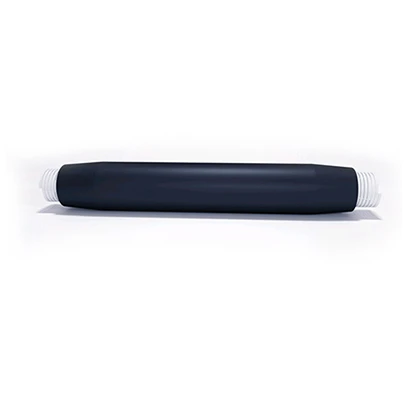
Waterproof intermediate joint
Model:
1 / 2
1
2
Description
The exterior of the waterproof intermediate joint is provided with water-blocking structural layers on the intermediate joint main body layer, inner sheath, and outer sheath respectively to achieve overall radial water blocking; at the connections between different interfaces, high-viscosity water-blocking materials are supplemented to enhance axial waterproofing. The interior of the waterproof intermediate joint adopts high-efficiency water-blocking materials and cable-core water-blocking technology. The materials have excellent conformability, creep property, and adhesion. Under the premise of water ingress into the cable core, the internal water-blocking materials can vary with the water volume to ensure waterproof performance, and the water-blocking performance does not change with time or operating temperature. The internal water-blocking structure is composed of conductive materials, stress control materials, and insulating materials. Among them, the conductive material has high conductivity, good adhesion to metal and PE, no water absorption, good conformability, and no hardening. Its function is to restore the inner semiconductive layer of the conductor, achieve long-term water blocking at the conductor screen break, and prevent water in the cable core from overflowing. The stress control material has stable performance and good adhesion to metal and PE. Its function is to equalize the electric field distribution and control the electrical stress on the surface of the inner semiconductive layer. The insulating material has a dielectric constant similar to that of cable insulation and good adhesion to PE and SR. Its function is to enhance the insulation performance at the intermediate connection, weaken the interface effect, and restore the internal water blocking of the joint. The waterproof intermediate joint features internal and external bidirectional water blocking at the intermediate joint position, excellent electrical performance, and convenient installation. Product features: Water-blocking materials: 1. Conductive material: high conductivity, good adhesion to metal and PE, no water absorption, good conformability, creepable, stable water-blocking and electrical performance. 2. Stress control material: stable performance, good adhesion to metal and PE. 3. Insulating material: dielectric constant similar to that of insulation, elongation at break.